Plug-in and wire-in galvanic isolators both give exactly the same level of protection against hull corrosion from shore power, so you are not gaining or losing protection by choosing one style over the other. In other words, the choice isn’t about effectiveness at all – it is purely about how you prefer to install and use the unit on your own boat.
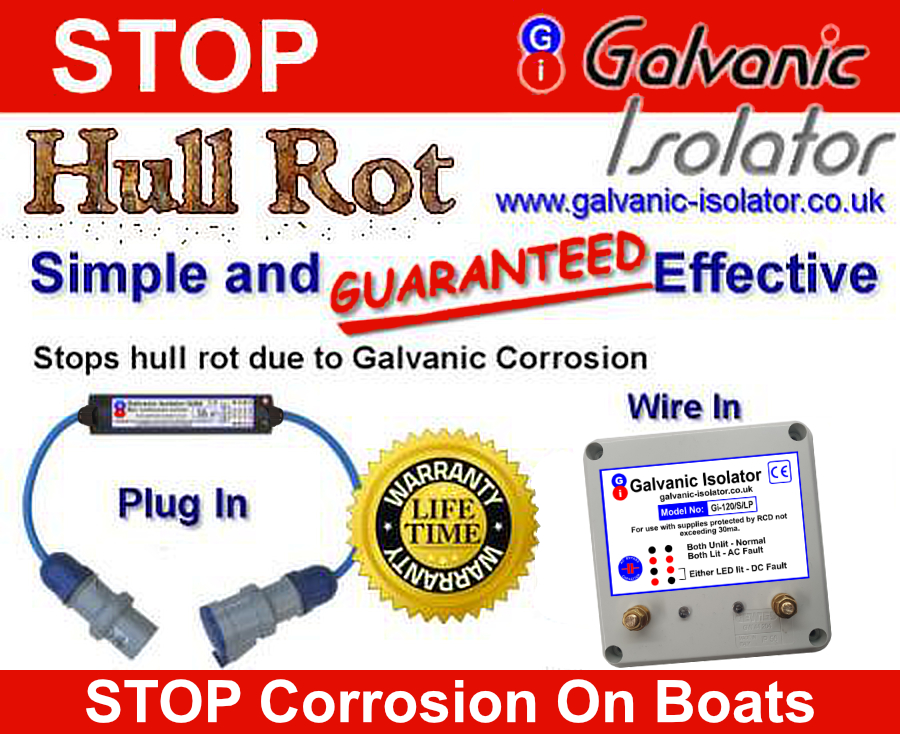
A plug-in isolator simply plugs inline with your shore lead, so it’s quick to connect, and ideal if you’d rather not touch the boat’s wiring or drill any holes. Because it lives on the cable, you can move it easily between boats, or take it with you if you change craft, and it works with any length or hull material in fresh, brackish, or salt water. This style particularly suits owners who want a straightforward DIY solution, with no tools, no access panels to remove, and no need to understand the details of the onboard electrical system.
Wire-in isolators are connected permanently inside the boat’s electrical system, which some owners prefer for a more “fit and forget” solution that is always in circuit whenever the boat is plugged into shore power. Our wire-in models use compact FlatPac semiconductors, so they take up very little space, and one model covers all boat sizes, hull types and both 16A and 32A supplies, just like the plug-in version. They do, however, require access to the boat’s wiring and a level of confidence working on it, unless you ask a marine electrician to install the unit for you.
So if you mainly value simplicity and easy DIY fitting, a plug-in unit has a clear edge in day-to-day convenience, with absolutely no compromise in performance or corrosion protection compared to a wired-in model. If you like the idea of a neat, permanently mounted device that becomes part of your boat’s fixed wiring, then a wire-in isolator may feel more satisfying, but in practical terms both options give your hull exactly the same defence against galvanic currents from shore power.
For more information, please click <HERE>